Showing posts sorted by relevance for query style manual. Sort by date Show all posts

Monday, November 23, 2020

My Suggestions to Tax Court on Procedure Related Matters (11/23/20)

On September 1, 2020, I sent the Tax Court Clerk a letter with suggestions regarding matters related somewhat to tax procedure.  A copy of the letter is here.  I have not had any response to the letter.  I thought I would excerpt and post the contents of the letter here in the event others might be interested in the subjects:

September 1, 2020

Stephanie A. Servoss
Clerk of the Court
United States Tax Court
400 Second Street, NW
Washington, D.C. 20217

Re: Suggestions for Tax Court Rules or Other Practices

Dear Ms. Servoss:

I write to make suggestions that might be incorporated in Tax Court Rules or otherwise adopted:

1. Make Public Tax Court Style Manual.  If there is a Tax Court style manual or other similar guide for judges (such as there is, for example, in the U.S. Supreme Court), I think the taxpayers and the bar would benefit from that style manual being public information.  I have been informed that there is such a Tax Court style manual or guide but that it is not public information.  The public need for access to the manual plays beyond checking to see whether judges conform to the manual (the Court may not require conformance, which I infer from deviations in practices, such as the location of periods and endquotes, that are normally covered by style manuals).   For example, commenters on such style manuals state that it is better practice to conform court submissions to the court=s style manual unless there is a good reason to deviate.  Whether that concern is fair or not is not the issue.  Whether the public should know the contents of the style manual is the issue, for such use as the public may choose to put those contents. 

2. Make Public Changes to Opinions After the Original Publication.  The Supreme Court advises the public of changes to Slip Opinions.  An example of such public notice of change is at: www.supremecourt.gov/opinions/19pdf/19 7diff_o7kq.pdf.  I recommend that a similar public disclosure be made for Tax Court opinions. 

3. Establish a Process for NonParties to Advise the Court of Possible Material Nonsubstantive Errors.  By nonsubstantive, I mean to exclude comments on application of the law to the facts found and legal analysis.  Nonsubstantive thus would include material comments on the syntax or such matters that can lead to confusion for readers.  Many of the errors of this sort are apparent and any reader may just mentally supply the corrections.  For example, I noticed a verb missing in a sentence recently, but it was easy to supply mentally and likely would not be confusing to most readers (although it may slow them down a bit to do the mental gymnastics).  But some errors may require the reader to work harder to understand the opinion and thus might be appropriate for correction, much as the Supreme Court does.  Parties would be expected to call outcome-determinative nonsubstantive errors to the Court's attention but may not call them to the Court's attention if they are not outcome-determinative.  Many nonparties study Tax Court opinions and spot such errors in the few cases in which they appear and could offer a valuable service to the Court, taxpayers and practitioners where the Court determined that correction is appropriate.  I understand from my sources that, from time to time, nonparties (generally practitioners) may write informally to the judge (by email or letter) advising of the nonsubstantive errors but, quite appropriately, do not hear back and do not know whether any action was taken (short of periodically checking the slip opinions or final T.C. opinion).  The point is that, I think, it would be helpful to all involved (including readers) to have a regularized process to get the information to the Court for such use as it may deem appropriate.  I do not think that any response would be required to the person making the comment or suggestion, other than perhaps a routine form thank you letter or email.  I also do not think it would be necessary to make those letters (or emails if included in the process) from nonparties public on the website or otherwise.  I suspect that most of the comments or suggestions will not require any action, but some may warrant action (e.g., correction of the slip opinions).

Thank you for considering these suggestions.

Sincerely yours,

John A. Townsend

cc: Alexandra Minkovich (by email: Alexandra.minkovich@bakermckenzie.com)
Chair, ABA Tax Section Court Procedure
and Practice Committee

Keith Fogg (by email: kfogg@law.harvard.edu)

JAT Comment:

Thursday, May 9, 2024

Notes on Dawson Available Documents and Tax Court Style Guide (5/9/24)

The purpose of this blog entry is to inform readers (some of whom may already know some of the items) of certain matters relating to Tax Court practice.

 MATTERS RELATED TO THE DAWSON SYSTEM:

1. Documents available Online in the DAWSON System. First, there is no permanent link for opinions. Those wanting opinions or orders have to do so in the following alternative manners:

a. the “Today’s Opinions” or “Today’s Orders” pages, here and here, respectively which are available only on day of publication);

b. through the Docket Entries for the specific Case, here.

c. through the Opinion Search here or Order Search here. In addition to specific opinion searches, the Opinion Search offers significant database search possibilities by types of opinions (T.C., Memorandum, Summary, and Bench), by Tax Court Judge, and by dates (this latter permitting a search for cases that are no longer on the Today’s Opinions discussed in paragraph 1.a.)

I am not sure precisely why there are no permanent links provided for opinions, although I understand it relates to the design of the DAWSON system.

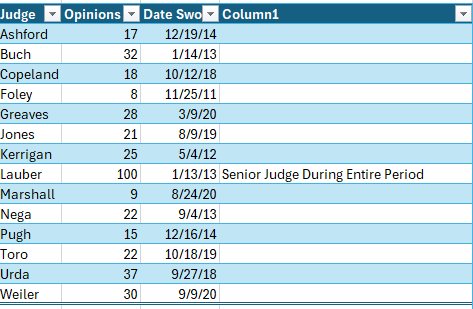
As to search by Judge with no other limiting parameters, the pages display only “first 100 matches;” in theory, this might limit the usefulness for certain types of studies. But within those parameters, certain analyses may be made. For example, having too much time on my hand, I wanted to see how productive the Active Judges were in terms of their T.C. and Memorandum Opinions. I started with a  prolific generator of opinions, Judge Lauber who, although a Senior Judge since January 1, 2020, produced 100 T.C. and Memorandum Opinions from 7/26/21 (the earliest date that the search reached the maximum 100 opinions for Judge Lauber) to present (5/9/24). I then used the tool to determine the number of opinions rendered by the presently active Judges during the same period. Here are the results:

Those are the raw data; I draw no conclusions from these data because I am sure there is a lot of nuance behind them.

Monday, June 1, 2020

Tax Court Administrative Orders on Trials in Pandemic Times (6/1/20)

Readers of this blog will be interested in two orders of the Tax Court issued last week:
  • Administrative Order No. 2020-02 on Remote Court Proceedings During COVID-19 Pandemic, here.  The order attaches sample Notice of Setting Case for Trial and Standing Pretrial Order (with Pretrial Memorandum Form) for regular cases as small cases and a Getting Ready for Trial Checklist.  The order says:
Given the ongoing uncertainties and the Court’s desire to continue essential operations, on May 29, 2020, the Court adopted procedures for conducting Court proceedings remotely. These procedures will be in effect until further notice. Sample orders and notices incorporating these procedures are attached to this Administrative Order and will be posted on the Court’s website under “Forms”. 
Public access to the Court’s remote proceedings will be made available via realtime  audio with dial-in information for each session posted on the Court website. 
This Order is effective immediately and shall continue in effect until terminated by this Court.
  • Administrative Order No. 2020-03 on Limited Entry of Appearance Procedures, Effective June 1, 2020, here.
Bob Probasco, here, of the Texas A&M Law School has an excellent Guest Blogger posting -- Significant Changes For Tax Litigation (Procedurally Taxing Blog 6/1/20), here.  So I won’t re-create the wheel here.  Bob does ask readers of the PT posting to offer their observations and questions.  So I encourage readers to watch the comments to Bob's posting and any replies that Bob or other readers may make to those comments.

Bob also noted in the posting:  
Another press release the same day informed us that on June 1st the court will resume accepting requests for copies of documents from non-parties.  But the process will be more flexible than before; requests can be made by phone and received by email.  You won’t have to – because you can’t – visit the court building in person.
I suspect that this "innovation" will survive the Pandemic--at least the email request or perhaps an internet form to make the request and any payment required.

A Detour:  I note that the order has a quote around Forms at the end of the sentence and places the period outside the endquote.  The secret Tax Court style manual, as it was explained to me, should have required that period (consistent with the American practice) to be placed inside the endquote.  See Updates on the Tax Court's Continued Love Affair with Periods Outside Quotations (1/4/20; 2/29/20), here.  Perhaps the style manual applies only to decisions and the like and not to administrative orders.  Or perhaps the explanation I received is incorrect.  At any rate, does the Tax Court really need to keep its style manual secret?

Monday, July 20, 2026

Eleventh Circuit Rejects Bullshit Conservation Easement Shelter (7/20/26; 7/27/26)

In Savannah Shoals, LLC v. Commissioner, ___ F.4th ___ (11th Cir. 2026), CA11 here and GS here, the Eleventh Circuit rejects the appeal of a bullshit conservation easement shelter. The result is foretold in the first paragraph of the opinion, noting that the shelter claimed a “$23 million” deduction for an easement found by the Tax Court to be worth $480,000. See Judge Goeke’s opinion Savannah Shoals LLC v. Commissioner, T.C. Memo. 2024-35, here.

I won’t discuss the opinion further because, although it is 34 pages long and is designated “FOR PUBLICATION,” I don’t think it adds anything material to previously developed law, factual conclusions, and appellate review. The bottom-line is for taxpayers and promoters to avoid bullshit claims, including bullshit claims on the Tax Court’s valuations. The Court does not say that or even, for most readers, fairly imply that. Still, that is my inference. And, of course, plenty of other opinions, including from this Court, can be read for that proposition.

One interesting point is that oral argument was 12/10/25 and the unanimous opinion was 7/16/26, for 218 days gestation period for a 34 page opinion of little precedential value. (See CL docket entries here).

However, I will make some comments which are even more picky.

JAT Comments:

 1. The Court discusses the shelter’s attack on the IRS expert. (See Slip Op. 10-16.) The Court spends some time discussing FRE 702 and the Daubert Standard. As it turns out, immediately before I read Savannah Shoals, I had just revised my Federal Tax Procedure Practitioner Edition to add a footnote on the text reference to FRE 702. I just copy and paste that footnote discussion because I don’t think the Court in Savannah Shoals picked up the nuance even though I don’t think the nuance would have changed the outcome.

Thursday, January 23, 2020

Does the Period Go Inside or Outside the End Quote? A Tax Court and Supreme Court Comparison (1/23/20; 1/25/20)

Added 4/9/20:  I have been advised that the Tax Court has a style manual that, paraphrased, says the rule is:  "periods go inside quotes only if the period is part of the quote (ie you are quoting to the end of the quoted sentence).  Otherwise, periods go outside the quote because the period is not part of the quote."  (Caveat: for the foregoing paraphrasing which I received from another person, I followed the Supreme Court style manual by including the period inside the quote even though the original had additional words before the period in the original.) I have not  seen the manual and am  trying to obtain a copy.  If anyone knows of a public link to it or has it and can provide it to me, I would greatly appreciate it.  (Please email to jack@tjtaxlaw.com.)

The balance of this web post is the same as it existed prior to 4/9/20.

Note that this blog has been revised, most importantly, to include the Supreme Court Style Guide.  See below after the spreadsheet on Supreme Court opinions.

Also, I am updating the lists below from time to time on a page to the right titled: Updates on the Tax Court's Continued Love Affair with Periods Outside Quotations (1/4/20; 2/29/20), here.

Readers will have noticed that, occasionally, in my blogs I nit pick, but usually only as a detour from the topic of the blog.  Today, a nit pick is the topic of the blog.

Recently, I started paying some attention to the Tax Court opinions placement of end quotes – inside or outside the period.  I noticed that in some of my anecdotal reads that Tax Court opinions (of all sorts, T.C., and T.C.M. and Summary) are inconsistent on that weighty topic.

The American rule, as I understand is, always inside the end quote.  See, e.g.:
  • Dreyer’s English (2019), p. 55 (“Though semicolons, because they are elusive and enigmatic and they like it that way, are set outside terminal quotation marks, periods and commas—and if I make this point once, I’ll make it a thousand times, and trust me, I will—are always set inside. Always.”)
  • Why do periods and commas go inside quotation marks in MLA style? (The MLA (Modern Language Association) Style Center 2/1/2018), here (“ William Strunk, Jr., and E. B. White, writing in 1959, noted that ‘[t]ypographical usage dictates the comma be inside the marks, though logically it seems not to belong there’” and “if you are preparing a paper for a class or for publication in the United States, place periods and commas inside quotation marks.”)
  • How to Use Quotation Marks: mysteries of combining quotation marks with other punctuation marks (Grammar Girl Quick and Dirty Tips 12/26/13), here, (“ in American English we always put periods and commas inside quotation marks”).
  • Periods and Quotation Marks (The Writing Cooperative 9/1/18), here (“The period should go inside the quotation marks.”
  • Bryan A. Garner, Correct Placement Of Punctuation In Relation To Quotation Marks (Above the Law 5/12/14), here,
So, having a choice today between watching the impeachment hearings, I decided that I could better occupy myself with other things.  I did. One of those things was to prepare the spreadsheets offered below in this blog.

Thursday, May 7, 2020

Tax Court Conflates Standards for Testing Interpretive and Legislative Regulations (5/7/20; 5/11/20)

In Whirlpool Financial Corp. v. Commissioner, 154 T.C. ___ No. 9 (2020), here, the Tax Court (Judge Lauber) held that income from a foreign manufacturing and sales structure was foreign base company sales income (FBCSI) under § 954(d).  Whirlpool’s tax shenanigans to avoid that result failed.  I won’t get into the details of the underlying tax issues.  I focus here on the Court’s explanation of how it applied Chevron to approve a regulation interpretation that was important to the result.

The Court discusses the Chevron analysis at Slip Op. pp. 54-62.  The regulation in question interpreted § 954(d)(2).  Although the Court did not state whether the regulations were interpretive or legislative regulations, it seemed to treat the regulations as interpretive regulations, testing the regulations under “the familiar two-step test of Chevron, U.S.A., Inc. v. Nat. Res. Def. Council, Inc., 467 U.S. 837 (1984).”  (Slip Op. p. 54.)  As I have noted before, Chevron applies to an interpretive regulation, ultimately testing the reasonableness of an agency interpretation of ambiguous statutory text.  The questions are (i) is the interpretation within the scope of the statutory ambiguity and (ii) is the interpretation reasonable (sometimes called permissible).  By contrast, legislative regulations (such as the consolidated return regulations) are the law within the scope of the delegation and are not interpretations of the law, so testing a legislative regulation for reasonableness of the interpretation is an oxymoron.  Rather, legislative regulations are tested under the arbitrary, capricious or manifestly contrary to the statute standard under 5 U.S.C. § 706(2)(A); and Motor Vehicle Mfrs. Ass'n v. State Farm Mut. Auto. Ins. Co., 463 U.S. 29 (1983), focusing on the procedural regularity of the regulations promulgation process.  Questions I sometimes ask to those I engage on the subject are:  Do courts defer to statutes (deference being meaningful only to interpretations of statutes)? Since legislative regulations within the scope of the authority granted are the law just as if they were statutes and are not interpretations of the law, how exactly does a court defer to the legislative regulation?

As other courts have misread Chevron and subsequent cases, the Court conflated the two standards.  But, they are not the same standard, and the two standards do not apply to the same type of regulation.  I cite readers to my article, John A. Townsend, The Report of the Death of the Interpretive Regulation Is an Exaggeration (SSRN 1/25/20), here.  (Caveat, the main theme of the article and the points I make in this blog are rejected by many, if not most, scholars addressing the issue, as I note in setting up the discussion in the article; if error there be in my view, I still stick with it.)

These are the parts of Judge Lauber’s opinion that I think improperly conflate (or at least confuse) the two standards:

Tuesday, May 14, 2024

Further Lesson on Importance of Credibility for Clients and Expert Witnesses (5/14/24)

I recently blogged about credibility. Litigation is About Persuasion Which Requires Credibility (Federal Tax Procedure Blog 4/12/24; 4/23/24), here. The Tax Court yesterday issued an opinion, Schwarz v. Commissioner, T.C. Memo. 2024-55, TC Dkt 12347-20 at Doc 190, here and GS here, in which Senior Judge Goeke offers lessons on the same subject. Those lessons appear in about 17 pages of the 117 page opinion. I’ll discuss the pages, but first offer an introduction to the case via the Court summary or syllabus at the beginning. See Supreme Court Opinion Syllabus as Persuasive Authority? (Federal Tax Procedure Blog 2/8/21), here):

          Ps have a history of conducting real estate activities in South Texas, mostly involving ranch land. Through entities they controlled, Ps bought 15,070 acres of land in Zapata County in 2005 with the intent to improve and sell it. Ps later decided to conduct ecotourism operations consisting of hunting, fishing, and events on a portion of the land.

          In the years at issue, 2015–17, ecotourism in Zapata County was conducted by TI, a partnership owned by Ps. TI leased the Zapata County land from entities controlled by Ps. TI also conducted farming and construction operations on the Zapata County land and other properties owned by Ps, related entities, and third parties.

          TI filed Schedule F, Profit or Loss From Farming, with its return for each year 2005–20. TI reported income and expenses for both ecotourism and farming/construction operations on Schedule F. TI reported Schedule F gross income totaling over $14 million for years 2005–20. However, large expenses resulted in TI’s reporting a Schedule F net loss for each year. These net losses total over $15 million for years 2005–20. TI’s Schedule F losses flowed through to Ps, who used them to offset significant taxable income.

          R issued Ps a notice of deficiency for years 2015–17. R determined that TI’s Schedule F activity was not engaged in for profit pursuant to I.R.C. § 183. Multiple adjustments flowed from this determination, including the disallowance of deductions for TI’s Schedule F losses. R also determined that a 20% accuracy-related penalty applies for each year at issue.

          Ps filed a Petition challenging R’s determinations. Ps contend that TI’s Schedule F activity was engaged in for profit and that it and the real estate activities that Ps and related entities conducted are a single activity. Ps also contend they have a reasonable cause defense to penalties.

          Held: TI’s Schedule F activity and the real estate activities are separate activities.

          Held, further, TI’s Schedule F activity was not engaged in with the intent to make a profit.

          Held, further, accuracy-related penalties are not applicable. 

Thursday, May 14, 2020

Tax Court Sustains Key Conservation Easement Regulation But Wobbles on Legislative/Interpretive Regulation Issue (5/14/20; 5/26/20)

In Oakbrook Land Holdings, LLC v. Commissioner, 154 T.C. 180 (2020) (reviewed opinion), here, the Tax Court upheld the Treasury Regulation’s interpretation of § 170(h)(5)’s requirement that the easement be “protected in perpetuity.”  The Court first held (Slip Op. 9-25) that the promulgation process was not procedurally defective, it was not arbitrary or capricious.  The Court next held (Slip Op. 26-33) that the interpretation met Chevron’s Step Two test that it reasonably interpret the ambiguous statutory text and was therefore entitled to deference.

In reaching its conclusions, the majority opinion treated the regulation as a legislative regulation.  I think the Court was wrong in doing so and will summarize my reasons.  But, I think that if the Court had properly treated the interpretation as an interpretive regulation, it would have gone through the same process–i.e., it would have found the promulgation of the interpretive regulation to be procedurally proper and it would have found the interpretation a reasonable interpretation of the statute under Chevron Step Two.

So, my quibble over the proper characterization of the regulation interpretation of the “protected in perpetuity” statutory requirement would not, if correct, reach a different result.

What the Court did not find and could not find was an express congressional delegation of legislative rulemaking authority such as, in the quintessential tax example, the delegation of authority in § 1502 to promulgate consolidated return regulations that are the law.  Section 1502 is a delegation to the IRS to make the law and not just to interpret the text of § 1502.

Rather, all the Tax Court could find was (i) ambiguity in the statutory term “protected in perpetuity” and (ii) a regulation fleshing out details of that statutory text in a way the Court found reasonable in Chevron Step Two (although presenting the Chevron analysis as arbitrary and capricious review).  In this respect, the regulation interpretation of “protected in perpetuity” is like one of the classic interpretive regulations approved by the Supreme Court in United States v. Correll, 389 U.S. 299 (1967) where the regulation interpreted the statutory term “away from home” for business expense deduction to require sleep or rest.

The Court’s reasoning, after positing glittering generalities about the difference between legislative and interpretive regulations was (Slip Op. 17):
Because the regulation imposes a requirement not explicitly set forth in the statute, it is appropriately treated as a legislative rule.

Tuesday, September 11, 2012

Birkenfeld Gets $104 Million Whistleblower Award (9/11/12)

Bradley Birkenfeld the Whistleblower who whistleblowing brought UBS to its knees and set in motion the IRS offensive against Swiss and other foreign banks has been awarded $104 million as a whistleblower award under Section 7623(b), here.  Birkenfeld was also convicted and sentenced for crimes related to his alleged reticence in coming fully clean.  Still, he was the man.  He was formerly named Tax Analysts "Person of the Year" for 2009.

This is a stunning development.  I am sure there will be a lot of buzz and hype.  But I do think this signals some significant movement in the Whistle Blower office.

Also, since the Swiss would say that his whistleblowing violated its law, we now know that the IRS admits having used the information in violation of other country law to collect revenue (which is what is required to grant an award).  So for all who thought that our Government might not used illegally obtained information, think again.  See also Payner v. United States, 447 U.S. 727 (1980), here, Government can use against a depositor information from a "flagrantly illegal search."

Resources:

Thursday, August 2, 2018

SSRN Posting of Article on IRS Guidance -- Rulemaking and Deference (8/2/18)

SSRN has posted for review and download my article on IRS Guidance.  titled IRS Guidance – Rulemaking and Deference to IRS Statutory Interpretation. Townsend, John A., IRS Guidance – Rulemaking and Deference to IRS Statutory Interpretation (July 27, 2018). Available at SSRN: https://ssrn.com/abstract=3212060`.

The Abstract is:
This article deals with one of the key intersections of federal tax law and administrative law: IRS rulemaking. The IRS makes rules that affect the public through regulations and subregulatory guidance. I first discuss the IRS process for issuing such guidance and the principal forms the IRS uses. I then discuss the administrative law concept of deference to agency statutory interpretations. In administrative law, the two key regimes for deference are Chevron deference and Skidmore deference. Chevron deference requires the court to defer to an agency interpretation in formal guidance when the statutory text being interpreted is ambiguous and the agency interpretation is a reasonable interpretation even though the court believes there is a more reasonable interpretation. In the IRS context, Chevron deference applies to Treasury Regulations. Skidmore deference requires the court to defer to an agency interpretation in subregulatory guidance to the extent that the interpretation is persuasive. (That Skidmore formulation may sound a bit odd, but I get into that in the article.)  
The nonmainstream discussion in the article has two interrelated components: First, Chevron does not apply to legislative regulations. Legislative regulations are regulations, exemplified in the tax area by the consolidated return regulations under § 1502, where Congress delegated to the IRS the power to make the law. Second, Chevron does apply to interpretive regulations--regulations which interpret the statutory text. Some authors assert that, if Chevron deference applies to give the interpretation the force of law, then the regulation is a legislative regulation with the APA requirements for legislative regulations--promulgation in the Federal Register and prospective application only. The same argument, presumably, would apply if Skidmore or any other deference is given to an IRS interpretation in subregulatory guidance, because by conferring deference the interpretation has the force of law. I disagree with those authors. I assert that a court adopting--deferring to, if you will--an agency interpretation of ambiguous statutory text does not transform interpretation into legislative rulemaking under the APA. Hence, for such agency interpretations promulgation in the Federal Register is not required and the interpretations can apply retroactively. The IRS usually does issue its formal interpretations in regulations subject to notice and comment, so that is not a key difference. But, IRS interpretive regulations can and often do have retroactive effect.
Additional Notes:

1.  This article started with the related discussion in the 2017 Editions of the Federal Tax Procedure Book.  It was too long for the intended audience of that book, so I excerpted that discussion and shortened the discussion of the topics for the book.  The more summary discussion in the Book is at pp. 37-69 of the Student Edition and pp. 53-94 of the Practitioner Edition.  Readers interested in the subject might first want to review the more summary discussion, particularly in the Practitioner Edition with footnotes.

2.  I substantially revised the longer discussion which I excerpted from the 2017 Book and, hopefully improved on it as I made it even longer.  Those interested in more detail than offered in the Book will find it here.

3.  I do discuss toward the end of the article the current political climate where Chevron deference has become a scapegoat for all the perceived ills of the administrative state.  My own view is that Chevron deference and its related deference forms (Auer and Skidmore) may not be perfect but offer a better framework for dealing with interpretations of complex statutory systems Congress expects agencies to administer.  Nonetheless, as I conclude the article, "But with these cross-currents of politics, repeal of Chevron may be a bad idea whose time has come."

Here is the Table of Contents for the Article:

Thursday, October 19, 2017

More on Skidmore (10/19/17)

I recently posted on Skidmore deference:  Other Views of Skidmore "Deference" (10/12/17; 10/15/17), here.  I offer more here on Skidmore, having searched through my database I keep to catalog items that I either actually read or wished I had read.  I just did a simple search on Skidmore.  I got about 525 hits indicating the sections in which Skidmore is cited (some sections had more than two references to Skidmore).  I browsed through the hits and offer the following additional excerpts about Skidmore deference.  I do caution readers than this is not a scientific or representative sampling of all the literature that is out there.

Kristin E. Hickman and Matthew D. Krueger, In Search of the Modern Skidmore Standard, 107 Colum. L. Rev. 1235, 1250, 1252-1253, 1255-1256, 1271, 1280-1281, 1291, 1310 (2007), here (footnotes omitted):
II. What Is Skidmore Deference? 
Drawing fine distinctions among deference standards may seem a purely academic exercise. Legal realists contend that such an effort is pointless, as courts only invoke deference standards to justify their preferred outcome. Although we acknowledge that this critique may be true in some instances, we nevertheless submit to the contrary that deference standards matter. We accept that courts feel constrained by deference standards and speak sincerely when they discuss the application of those standards. 
It is easy enough to recognize the consensus view that Skidmore gives judges more discretion than Chevron's command of mandatory deference. Similarly, from the Court's articulation of the two standards, one can readily discern that Chevron deference involves two binary inquiries, while Skidmore requires courts to evaluate several factors. Nevertheless, once a reviewing court finds itself in Skidmore's realm of discretionary deference, elucidating the appropriate degree of deference is not so simple as plotting a point on a line. Standards of review are not precision instruments. Rather, to paraphrase Justice Frankfurter, standards of review are more accurately described in terms of the "mood" a reviewing court should possess in evaluating the issue at bar. The question to be answered, therefore, is what sort of mood Skidmore analysis contemplates. 
* * * * 
Commentators also generally agree that Skidmore is less deferential than Chevron, falling somewhere further away from the deference pole. This is all well and good, but it offers little guidance for the application of Skidmore as a stand-alone doctrine. 
* * * * 
The independent judgment model of Skidmore deference thus understands the "persuasiveness" of an administrative interpretation to depend ultimately on the interpretation's merits or rightness. This conception discounts Skidmore's contextual factors and does not require courts to regard the presence or absence of those factors as particularly relevant. At most, this view understands Skidmore to require "due regard" be given to the agency's view, while "instructing courts to adopt the statutory interpretations that they themselves deem best." In effect, then, Skidmore directs courts to treat the agency's view just as it would the view of any litigant.  
* * * *